
Building an AI Startup ?
How, why and where to build

Comparing the Old Way vs. New Way of building with AI in your product
Think about all the challenges any startup already faces:
achieving product/market fit
delivering value to customers
sales and marketing distribution
customer support
hiring and retaining talent
With an AI startup, formidable challenges were stacked on top of all those:
Curate and preprocess large data sets
Deliver exceptional performance in real-world applications:
Develop a multiple of machine learning models for different use-cases
Continuous QA and fine-tuning to improve accuracy, handle edge cases, and avoid model drift.
Manage all the infrastructure and cloud costs associated with running multiple large models
Secure resources to support this ambitious undertaking
Overall, Gen AI is a game-changer for AI startups. It levels the playing field and allows for more innovation.
Old Way vs. New Way
The Traditional Approach to Building an AI Startup:
Hire a Costly AI/ML Team:
Recruit scientists to develop models from scratch.
Employ engineers to manage the deployment pipeline.
Data Preparation:
Curate, clean, and preprocess large datasets needed for initial model training and continuous fine-tuning.
Model Training and Deployment:
Train and deploy models while managing cloud infrastructure.
Strive to meet high (often unrealistic) customer expectations for accuracy in real-world applications.
Multiple Models for Multiple Tasks:
Train distinct models for different tasks, such as sentiment analysis and summarization.
The Modern Approach, Faster and Leaner:
Integrate with a Gen AI API:
Use APIs like OpenAI with minimal coding required.
Write Prompts in Plain English:
No coding necessary; write prompts in natural language.
Fine-Tune with Small Datasets:
Improve accuracy with small datasets instead of curating large ones for model training from scratch.
One LLM Prompt for Multiple Tasks:
A single Large Language Model (LLM) prompt can handle various tasks, eliminating the need for multiple distinct models.
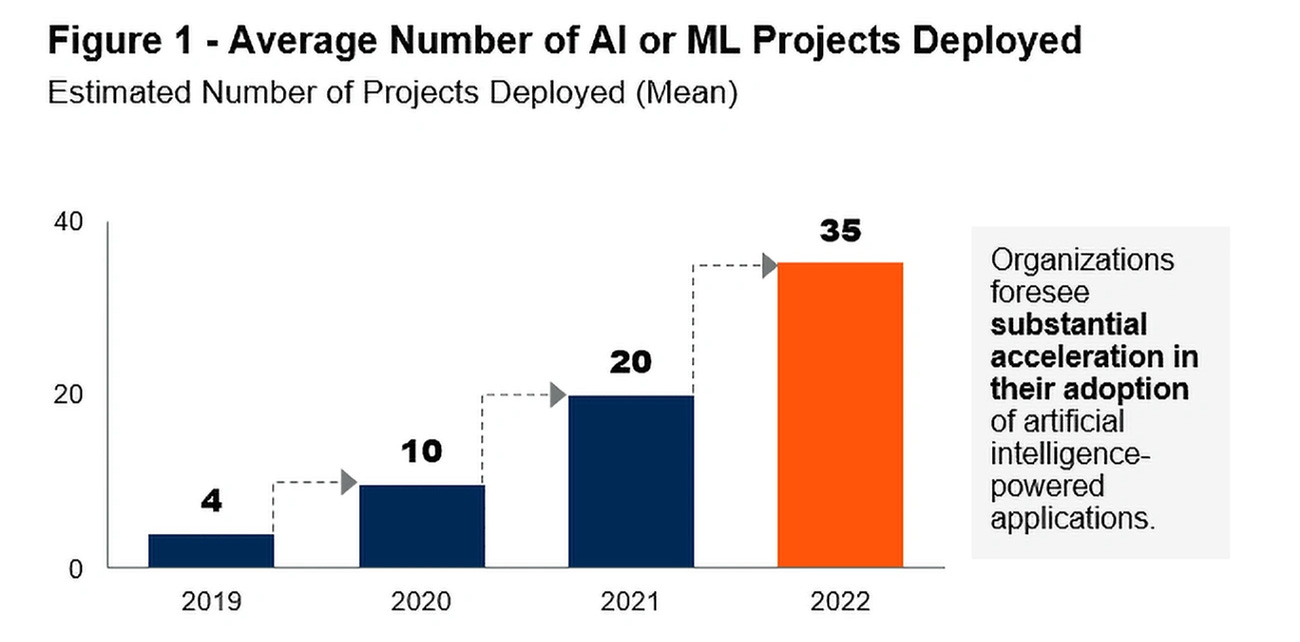
Summary: Benefits and Challenges of Accessible AI Tools
Benefits:
Lower Barrier to Entry: Gen AI tools enable entrepreneurs with minimal coding skills to participate in the AI space.
Faster Prototyping: These tools expedite the creation and testing of AI prototypes, allowing for quicker idea validation.
Focus on Value Proposition: Entrepreneurs can concentrate on refining their business models rather than dealing with AI's technical complexities.
Challenges:
Data Acquisition and Quality: High-quality data is essential but often difficult to obtain and manage.
Understanding AI Results: The complexity of AI models makes it hard to comprehend their limitations and biases.
Market Adoption: Gaining customer trust and demonstrating the value of new AI solutions is challenging but necessary for success.
What can startups build in or using AI ?
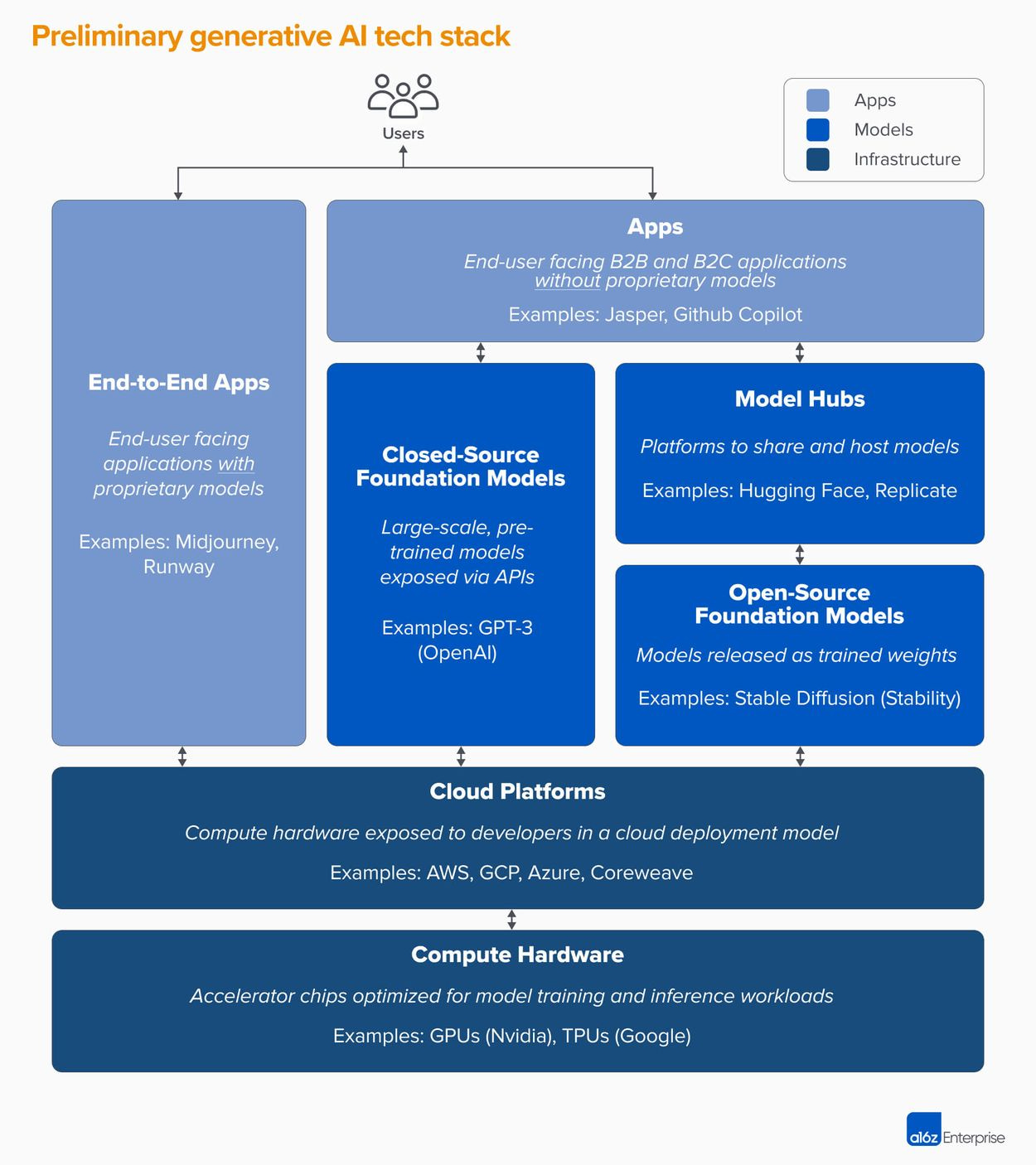
As discussed earlier there are broadly 3 layers in an AI system:
Infrastructure - Cloud & compute
Model - large scaled algorithms and supporting platform
Applications - User facing use-case of the AI system
Infrastructure
There are incumbents already existing in this space
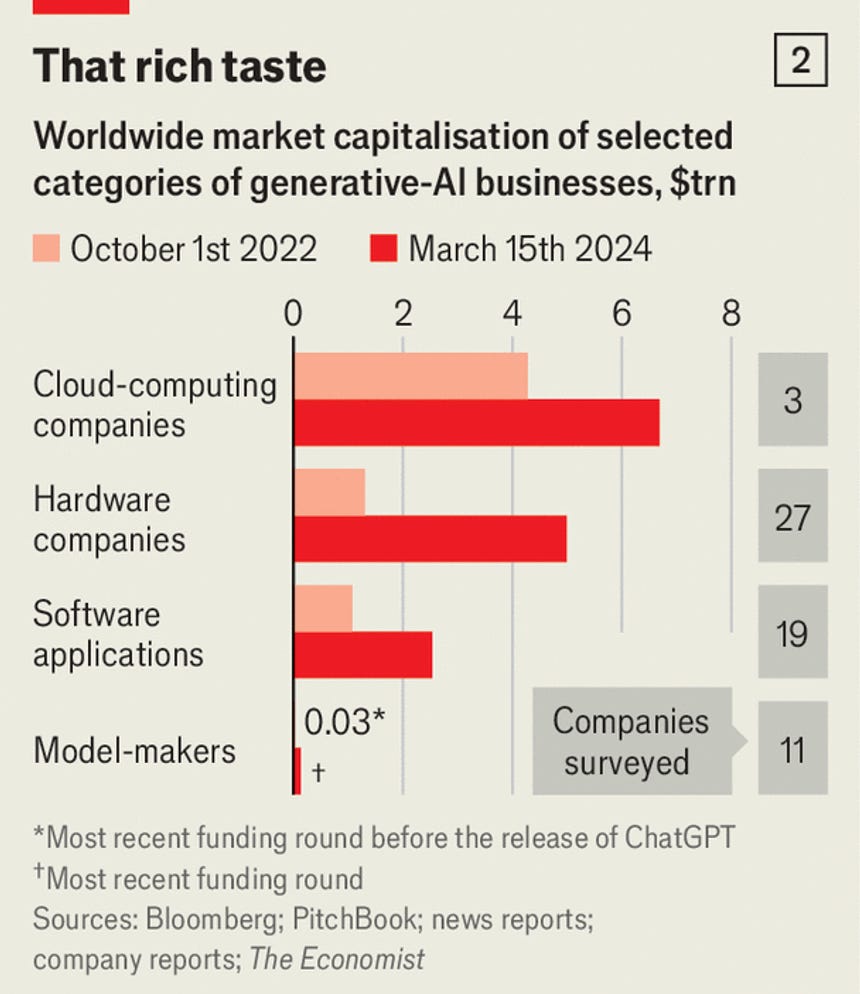
Hardware Titans Surge: From $1.5T to $5T, Nvidia’s epic leap to ~ $3T caps hardware’s dominance in the AI arena.
Cloud Giants Aim High: Amazon, Google, Microsoft—$2.5T up, betting big on owning the AI ecosystem.
Model
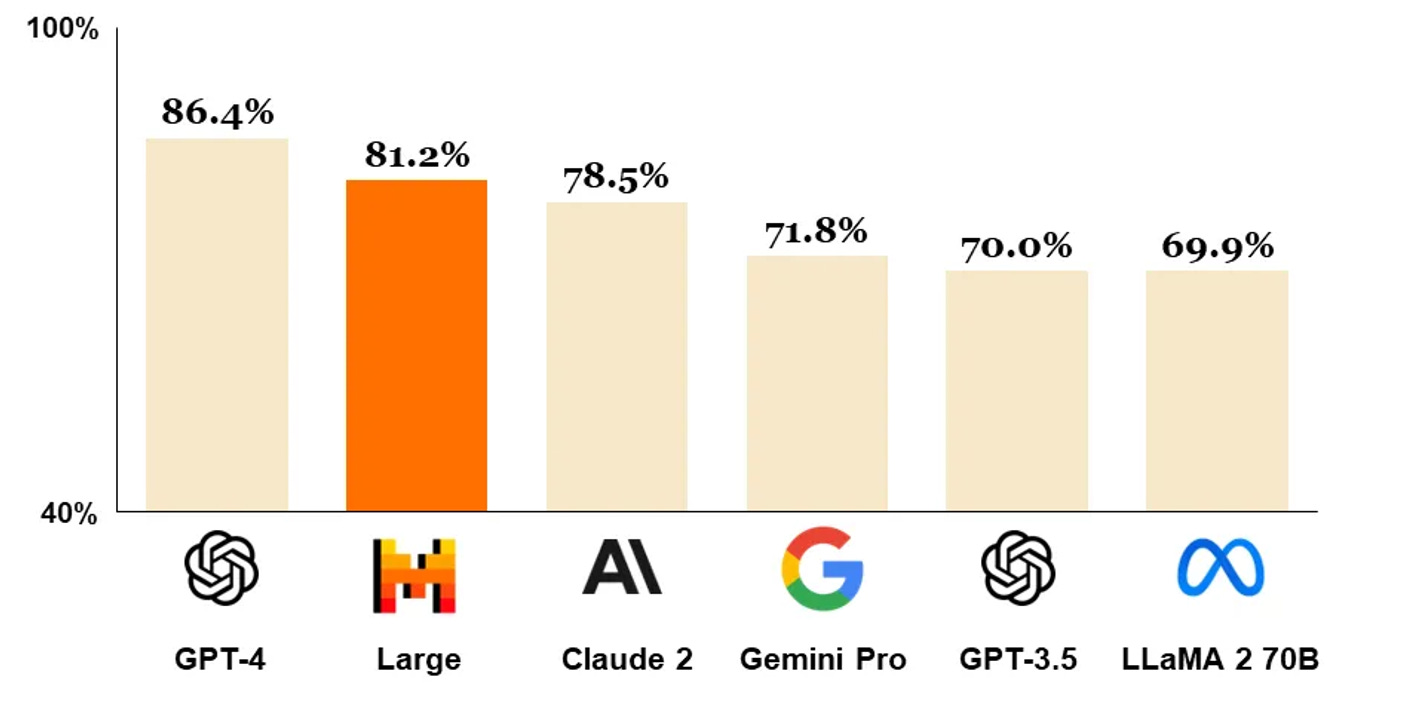
Model Makers’ Meteoric Rise: OpenAI & Anthropic lead with unprecedented valuations, spotlighting AI’s current intellectual gold.
Applications
What Is the Application Layer?
In the context of artificial intelligence (AI), the application layer refers to the part of a software stack where AI functionalities are implemented and interact directly with the end users. In other words, it serves the same function as the application layer in traditional computer systems.
This layer includes applications that use AI algorithms to perform specific tasks or provide services that are directly accessible and usable by people or other systems. Here are some key aspects of the application layer in AI:
User Interface (UI) – This includes the components through which users interact with the AI system, such as dashboards, chat interfaces, voice commands, or any other graphical user interface elements.
APIs and Services – The application layer often exposes functionalities through APIs or web services that allow other systems or applications to interact with the AI capabilities.
Application Logic – This involves the decision-making processes that are guided by AI models. It can include data processing, invoking machine learning models, and integrating AI-driven insights into the operational flow of the application.
Integration with AI Models – The application layer integrates pre-trained AI models or real-time machine learning algorithms that analyze data, make predictions, or automate tasks based on user input and other data sources.
Data Interaction – Although data processing often occurs at lower layers, the application layer manages the interaction with this data in a user-centric way, providing outputs and insights generated from the AI models directly to the users.
Overall, in AI applications, the application layer is where the capabilities of AI are made tangible and useful to users, putting sophisticated AI technologies within practical and often user-friendly interfaces. It’s that final piece of the AI infrastructure that allows us, end-users, access to the power of AI.
Examples:
Voice Assistants and Chatbots
Voice assistants like Siri, Alexa, and Google Assistant use natural language processing (NLP) to understand and respond to user commands. The application layer includes user interfaces and AI-generated responses.
Autonomous Vehicles
Autonomous vehicles use software in the application layer to interpret sensor and camera data for driving decisions, including user interfaces for setting destinations. Examples include Tesla’s Autopilot and Waymo.
Healthcare Diagnostics
AI in healthcare analyzes medical data for diagnosis and treatment recommendations. The application layer includes interfaces for doctors to input data and receive AI insights.
Financial Services
In financial services, platforms like robo-advisors use AI to analyze market data and user preferences for investment advice and portfolio management. Users interact with these platforms via web or mobile apps.
E-Commerce & Entertainment Recommendations
E-commerce platforms like Amazon and streaming services like Netflix use AI-based recommendation systems. These systems analyze user behavior to personalize recommendations, and the application layer is where users interact with these suggestions.
Is the application layer redundant ?
With OpenAI steamrolling multiple startup propositions with a new model release every 6 months.
It becomes a big question.
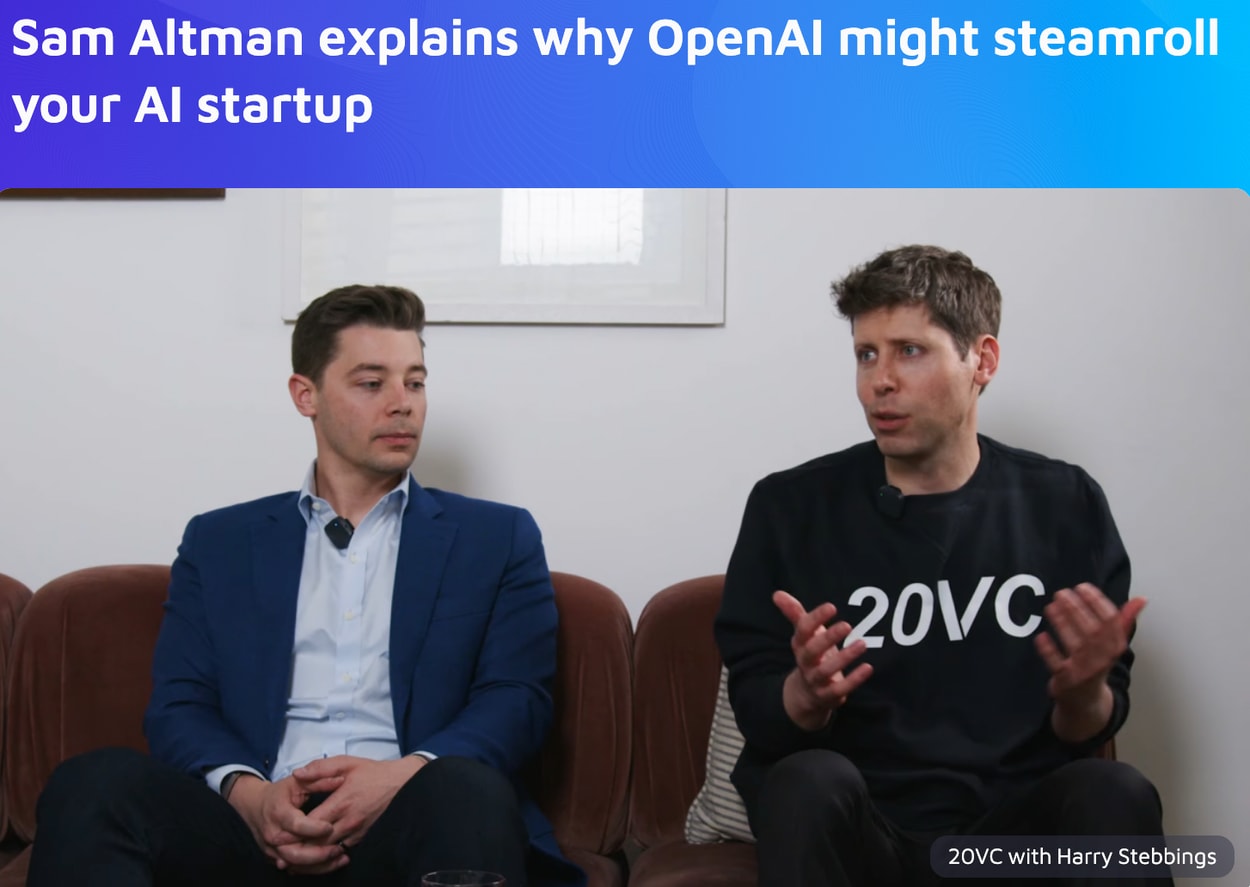
Sam Altman:
There are 2 strategies to build AI start-ups
Where you assume AI won't get better, and you build these little things on top.
Build assuming that the current foundation models improve 100x, the same improvement trajectory as it has been up to now.
If you choose 1 - when OpenAI just does its fundamental job which is just make the model and tooling better - you get steamrolled.
With the 2nd strategy, if this development looks advantageous for the startup, enhancing our overall position that’s a god place to start building in
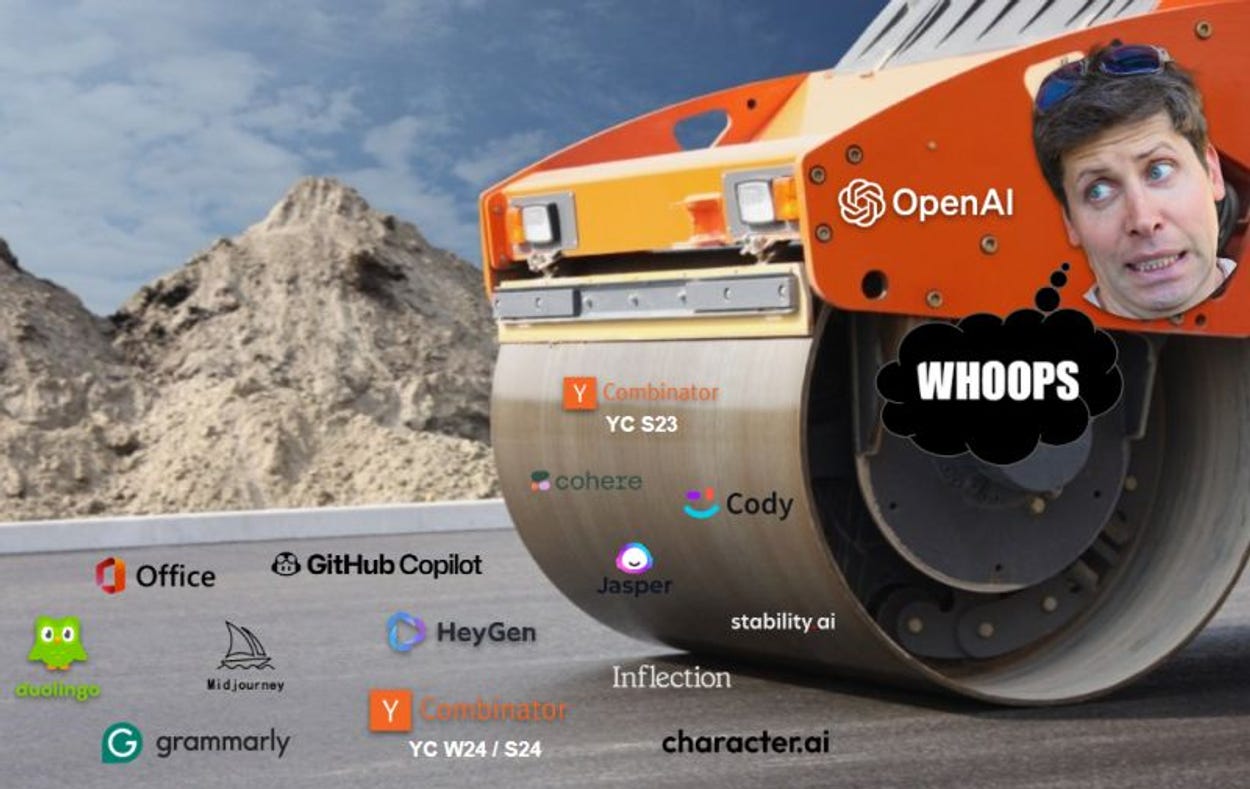
RIP to:
Notetaking apps, translation apps, assistance apps, image generating apps
Who will not be steamrolled by GPT-5?
Burst onto the Scene: Perplexity
Application that gets better with developments in foundational models.

Perplexity.ai is a relatively new search engine founded in 2022 that uses artificial intelligence to understand and answer your questions in a conversational way.
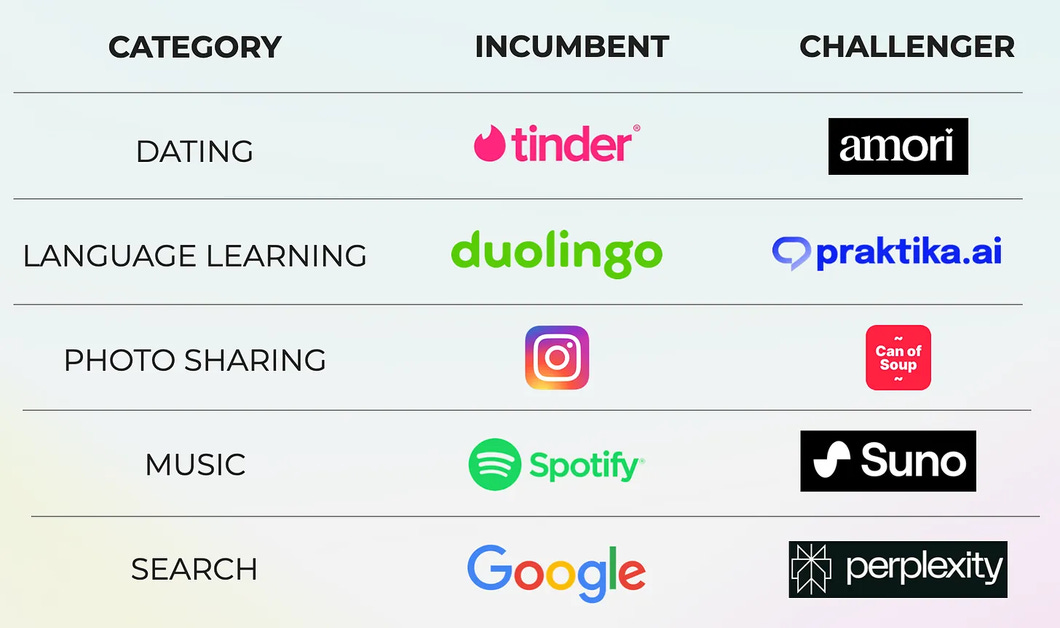
They are challenging Google on their search engine within a short period of time.
Things to consider:
Commoditization of foundational models is bound to happen, multiple older models are already commoditized.
It means models and their pricing will get cheaper as well
Perplexity does post-training - take any model from the market and shape it to be really good at search etc.
What is the future ? Follow the money
How VCs are Investing in AI
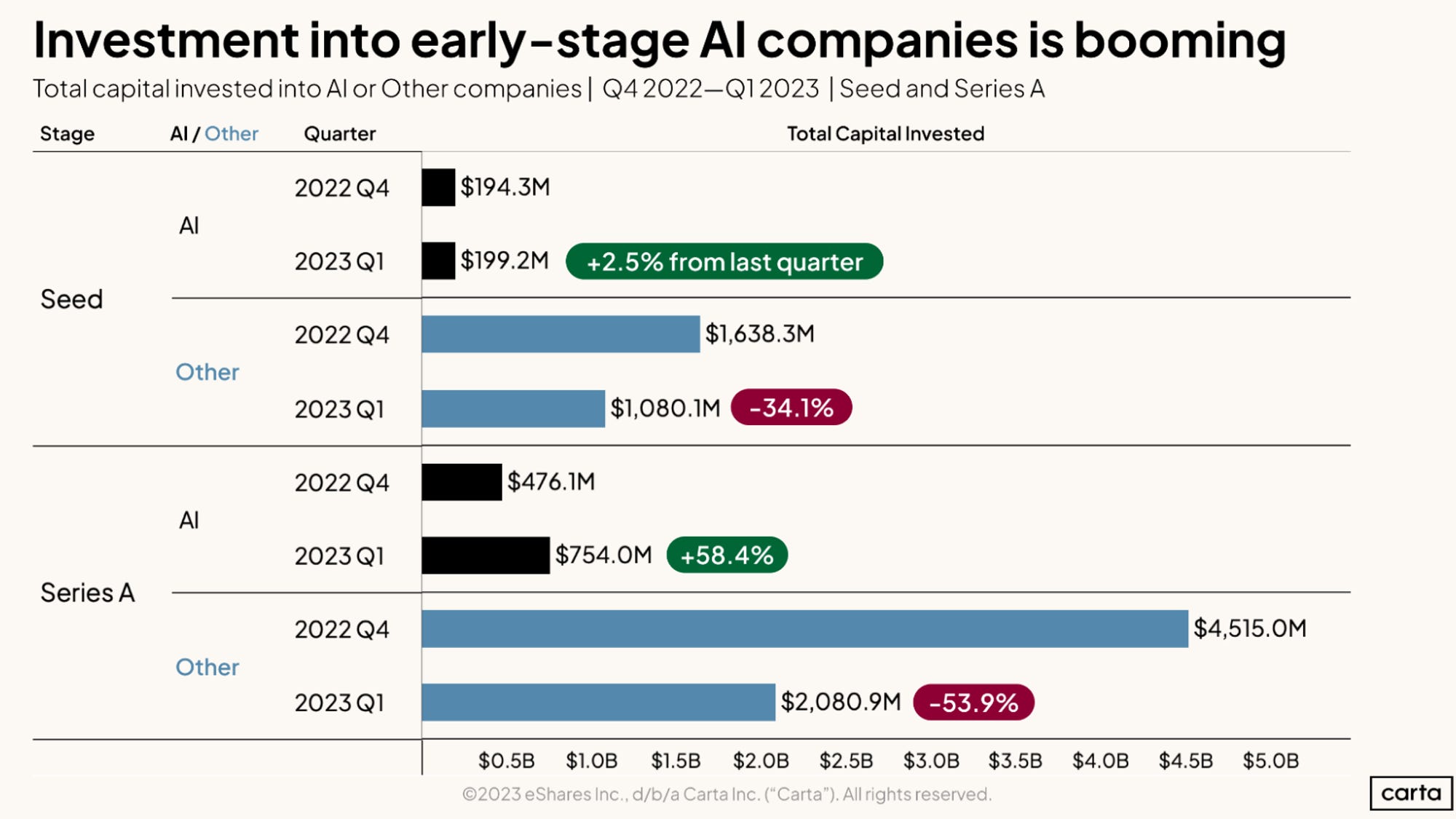
AI startups are capturing significant attention and resources from VCs. Goldman Sachs predicts that up to $200 billion will be invested globally in AI by 2025. This substantial capital influx is propelling the growth of innovative AI companies, enabling them to refine technologies, expand their reach, and develop groundbreaking applications.
Types of AI Companies Attracting VC Attention
VCs are investing in a diverse range of AI startups across various sectors, including:
Healthcare: AI-powered diagnostics and drug discovery tools.
Retail: AI for personalized product recommendations and enhanced customer experiences.
Transportation: Autonomous vehicles powered by AI.
Finance, Legal, and Climate Change: AI solutions tailored to these specific sectors.
These diverse applications underscore AI's broad impact and potential for substantial financial returns, further attracting VC investment and accelerating innovation.
Emerging Trends in AI Investment
VCs are now shifting their AI investment strategies towards practicality and away from hype, with several notable trends emerging:
Rise of Verticalized AI:
Investors are increasingly supporting AI startups focused on specific industries.
These companies leverage deep industry knowledge and data to create tailored solutions for sectors like healthcare, law, and climate change.
This focus reduces risk for investors, as established players find it harder to replicate these specialized solutions.
Enterprise Adoption of AI:
Large corporations have defined their AI strategies and are ready to invest.
They seek significant efficiencies and business improvements, such as enhanced product quality, faster market response, higher customer satisfaction, and staff reductions.
Focus on Business Fundamentals:
Investors prioritize AI startups with clear business models and demonstrable return on investment (ROI).
This shift may negatively impact companies that previously focused on state-of-the-art technology demonstrations without a strong value proposition.
AI Becomes Embedded Technology:
VCs foresee AI becoming a core functionality integrated into software across various domains, rather than a standalone industry.
Solutions powered by AI are seen as more attractive for investment than AI technologies searching for potential use cases.
Using AI in a product has become easier than ever, agentic AI applications are the future, and why success lies in leveraging the highly competitive foundational models → which will be commoditized in the near future.
Thanks for reading, would also love to hear your thoughts
Please feel free to connect with me on LinkedIn : linkedin.com/saharsh-sharma